
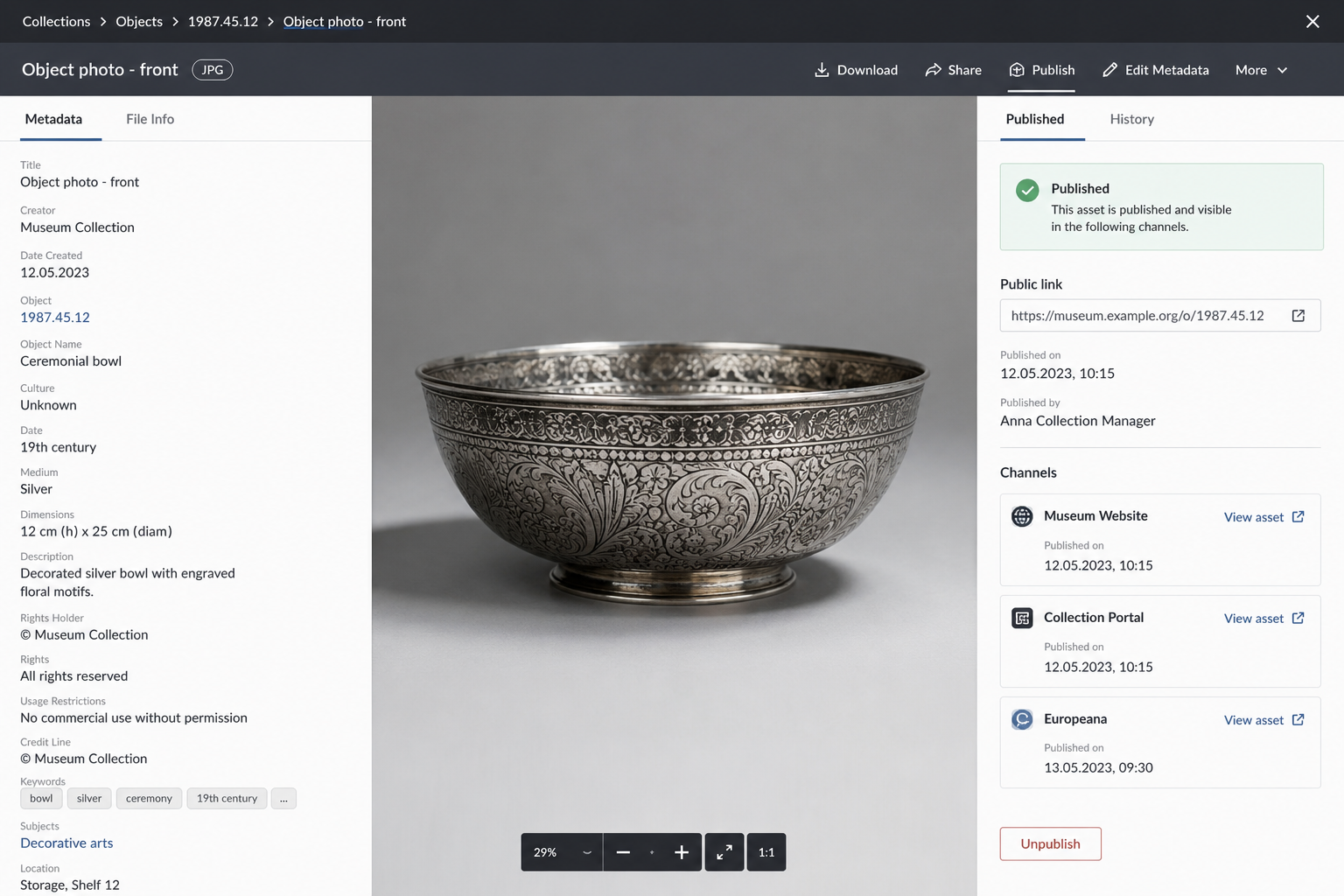
Search is often described as a feature. In reality, search is a user experience. People don’t want a search box—they want relevant results. They want to find the right thing, at the right time, with confidence that what they are using is accurate, permitted, and fit for purpose.
That experience—whether in a Digital Asset Management (DAM) system or any other application—is powered almost entirely by metadata. And while the technologies around search, AI, and automation continue to evolve, one truth remains unchanged: Without metadata, we are lost.
Moving beyond “metadata as labels”
Metadata is often framed as something you “add” to a file to make it searchable. A set of fields. A tagging exercise. A task to complete before moving on. But that view dramatically undersells what metadata really is.
Metadata is the culmination of knowledge inside an organisation.
It carries context, intent, history, and meaning.
It explains not just what an asset is, but why it exists, how it should be used, who it is for, and what constraints apply.
Metadata is not just an arrow pointing you in the right direction.
It is the story that travels with the asset as it moves through—and often beyond—your organisation.
The DAM ecosystem:
Where metadata actually lives
When we talk about a “DAM ecosystem,” we are really talking about movement:
Movement of assets, data, people, processes, and technologies. Metadata is the connective tissue that makes that movement intelligible.
Inside a DAM, metadata supports search and discovery. But its role extends far further:
-
It drives workflow automation and triggers
It governs rights, usage, and distribution
It determines where content can appear and who can access it
In other words, metadata is what elevates content into a true digital asset—with operational, strategic, financial, and legal value.
All Metadata is not static
One of the biggest misconceptions about metadata is that it is static. Add metadata. Done. In reality, metadata flows, grows, and evolves.
New information emerges.
Assets take on new purposes in new contexts.
As a result, metadata often needs to be revisited, refined, or redirected. Going back and changing direction is not a failure—it is a sign that metadata is doing its job.
All Metadata is not static because organisations are not static. One of the the first step to master this involves achieving flexible data harmonization—a process that establishes a shared language among all data users, facilitating universal comprehension and utilization of metadata. This offers a common metadata vocabulary that caters to diverse roles within enterprises, including taxonomists, ontologists, data architects and developers.
Just as language evolves over decades—or sometimes much faster inside companies—terminology, classifications, and meaning shift with human use. Metadata is a living system shaped by people. Machines can help with speed and scale, but humans remain essential for understanding cultural nuance and intent. Speed is only valuable if we are moving in the right direction.
Where metadata breaks down too often:
Leaving the DAM
Most teams encounter real trouble when assets leave the DAM. Files are pulled into creative tools, social media, documents, presentations, and downstream systems.
At that moment, the metadata story too often stops travelling with the file. Context is stripped away. Rights become unclear. Decisions are made without the full picture.
Controlled vocabularies, for example, are typically managed centrally within the DAM. That works—until assets exit the “safe haven” of the system. Once outside, metadata updates are no longer synchronized, protected, or preserved. The risk increases precisely where work actually happens.
This raises an important question: Are we planning metadata with those external touchpoints in mind? Metadata should remain meaningful and useful in other applications too.
More than search:
The full impact of metadata
Searchability and findability are important, but they are only one piece of the puzzle. Even when search is using large language models for visual recognition to find an image quickly, the usage of the result should always include metadata.
Active metadata determines:
-
What can and cannot be done with content
How it is distributed and automated
Who receives it and where it appears
How AI understands and works with it
As content moves through its lifecycle, metadata flourishes and evolves based on purpose, use, context, and business needs. This is why metadata is not overhead.
It is infrastructure.
Metadata does not begin when an asset is uploaded, and it does not end when an asset is archived. It grows with the organisation..It adapts to new realities.
The real challenge is not adding metadata—it is keeping the story intacts Authenticity of files in the world with AI-tools needs a solid metadata base to function reliable.
 |
Author Rolf Koppatz Rolf is the CEO and consultant at Communication Pro with long experience in DAMs, Managing Visual Files, Marketing Portals, Content Hubs and Computer Vision. Contact me at LinkedIn. |