
From answer to insight: When LLM search feeds the metadata loop
One of the most powerful—but still underexplored—opportunities in AI-enabled DAMs is not just that an LLM can return the right asset, but that it can explain why that asset was returned.
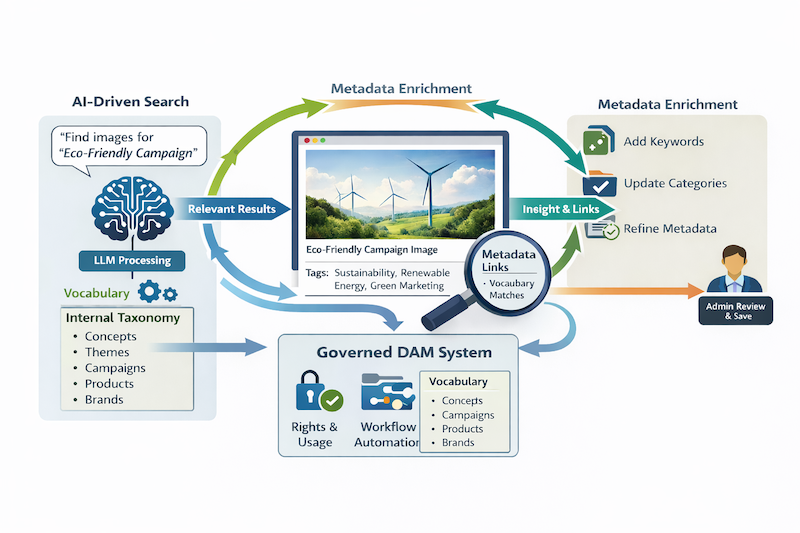
If an LLM-driven search surfaces the correct image and shows how it maps to the DAM’s controlled vocabulary—concepts, taxonomies, relationships, and business terms—the search result becomes more than an answer. It becomes insight.
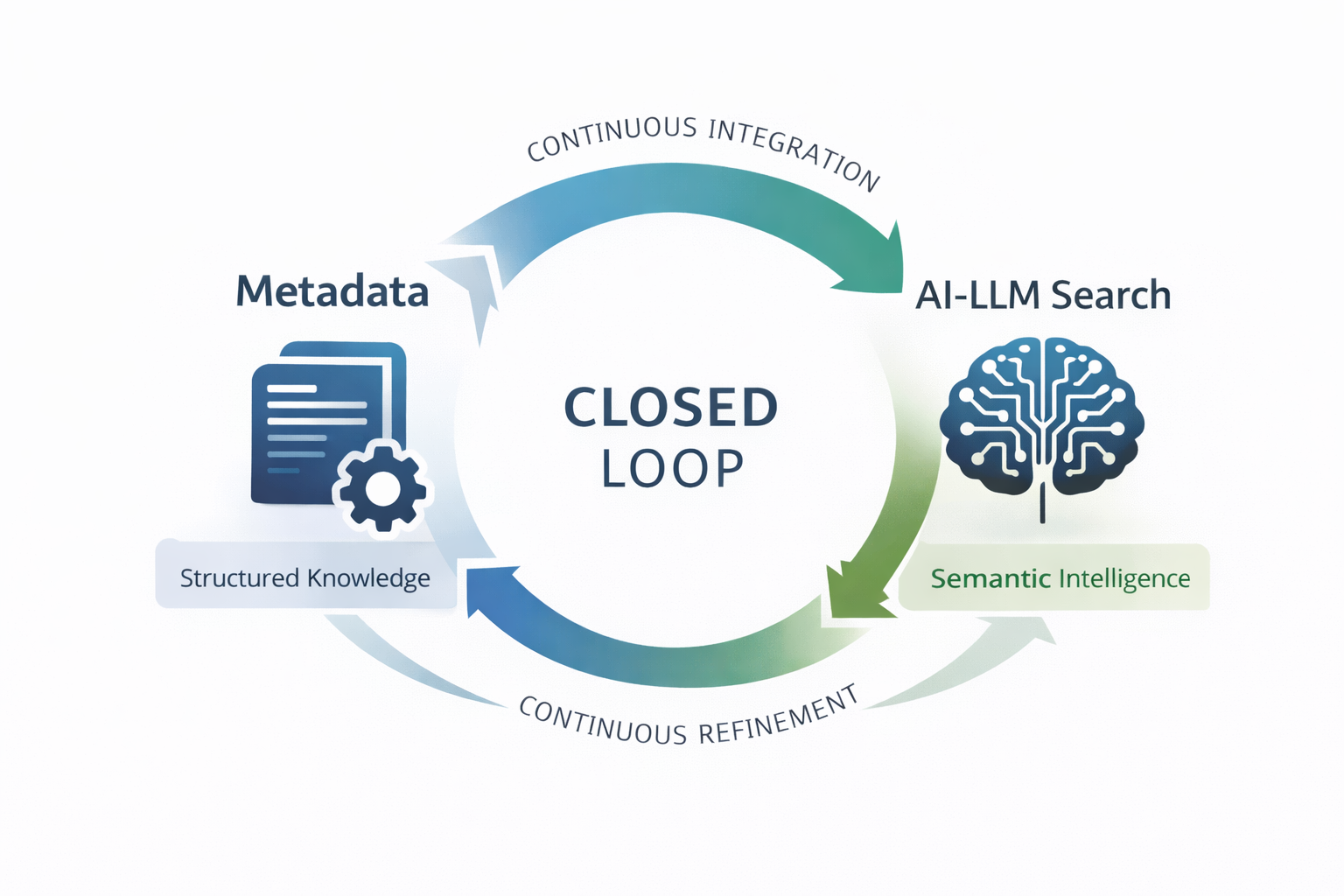
Suddenly, search is no longer a terminal action. It becomes part of a feedback loop.
AI, LLMs, and the metadata paradox
AI is changing how we search. Large Language Models (LLMs) have reshaped expectations almost overnight. Users can now type questions instead of keywords. They expect systems to “understand” intent, infer meaning, and surface relevant content without much effort on their part.
In DAM systems, this has led to a seductive promise by vendors:
“Just search with AI—no need to worry about metadata.”
But this is where a paradox emerges. As AI becomes more capable of interpreting content, the value of metadata actually increases—even as it appears, on the surface, to be less necessary.
Metadata as Ground Truth vs. AI as Interpretation
One useful way to think about the difference is this:
-
Metadata represents declared truth
-
AI represents probabilistic interpretation
Metadata encodes what an organisation knows and agrees upon: rights, ownership, lifecycle stage, approved usage, market applicability, regulatory constraints, lineage, and intent.
LLMs, on the other hand, infer meaning based on patterns in data. They are exceptionally good at understanding language and context—but they are not authoritative. They guess, with high confidence.
An AI model might infer what an asset appears to be about. Metadata is part of assigning and explaining and giving (more) meaning to data. Searchability and findability benefits are just one important reason among many for assigning metadata to content (digital assets).
Metadata tells you whether you are allowed to use it, where, when, and why. No amount of semantic similarity can reliably replace that. Metadata is what enables systems to do things, not just find things. Many of the most powerful DAM use cases remain deeply metadata-driven:
- Digital rights management
- Workflow automation and triggers
- Personalisation and omnichannel orchestration
- Compliance and auditability
Making relationships visible
Traditional search engines focus on relevance ranking and retrieval. LLM-based search can go further by exposing semantic relationships:
- Which taxonomy terms contributed to this result
- Which concepts were inferred vs. explicitly tagged
- How this asset relates to adjacent categories or campaigns
- Where vocabulary gaps or overlaps exist
By revealing these relationships, the system reinforces the DAM’s shared language instead of obscuring it. Users are not just consuming results—they are learning how the system “thinks” in organisational terms.
This is where metadata shifts from background infrastructure to active knowledge representation.
The administrative opportunity: Search as enrichment
For administrators and power users, this model unlocks a critical capability.
If an LLM-driven search shows that an asset was found because it implicitly aligns with a vocabulary term—but that term is not yet explicitly applied—then the system has identified a metadata enrichment opportunity.
In that moment:
- An admin can validate the AI’s reasoning
- Confirm or reject the association
- Persist the enriched metadata back into the DAM
Search becomes a metadata authoring surface.
Instead of enrichment being a separate, manual task, it is triggered by real usage and real intent. Metadata grows precisely where it creates value.
Closing the loop between discovery and governance
This approach also resolves a long-standing tension in DAM systems:
- End users want intuitive, language-based search
- Administrators need structured, governed metadata
LLMs can bridge that gap.
Natural language queries translate into semantic interpretations. Those interpretations are then anchored to controlled vocabularies. When validated, they strengthen the metadata layer rather than bypass it.
Over time, this creates a virtuous cycle:
- Users search naturally
- AI interprets intent semantically
- Results expose vocabulary relationships
- Admins validate and enrich
- Metadata improves
- Future searches become more precise
The DAM does not just respond—it learns, in a governed way.
Transparency builds trust
Another benefit of this model is trust. One of the biggest concerns with LLM-driven systems is opacity. Results appear, but users do not know why. By showing how a result maps to controlled vocabulary and metadata, the system makes its reasoning legible.
This transparency:
- Improves confidence in search results
- Reduces resistance from governance teams
- Makes AI decisions auditable
- Encourages adoption rather than skepticism
Trust is not built by hiding complexity—it is built by exposing meaning at the right level.
Metadata as a reinforced system
In this model, metadata truly becomes a living system. It evolves not only when someone decides to update a field, but when:
- Content is searched
- New questions are asked
- New relationships are inferred
- New business contexts emerge
The DAM remains the system of record. The vocabulary remains curated. The knowledge remains explicit. AI simply helps surface where that knowledge should grow next.
Adressing external users, if the API is done right, serves them as well. Users can access the DAM via the API using LLM textsearch to find assets and while accessing the assets getting a result also showing added keywords, filters and desciptions.
The Strategic Shift
The way I see the enhanced utilization of LLM is, that the real opportunity for vendors is to stop treating AI search as an endpoint. The value lies in connecting AI-driven insight back into metadata governance.
When search results show both what was found and how it relates to the DAM’s vocabulary—and when that insight can be persisted—search stops being disposable.It becomes cumulative. And that is when AI strengthens metadata. LLMs accelerate discovery, but metadata ensures continuity.
Did this wake up you interest?
Learn more here or book a online meeting here
 |
Author Rolf Koppatz Rolf is the CEO and consultant at Communication Pro with long experience in DAMs, Managing Visual Files, Marketing Portals, Content Hubs and Computer Vision. Contact me at LinkedIn. |