
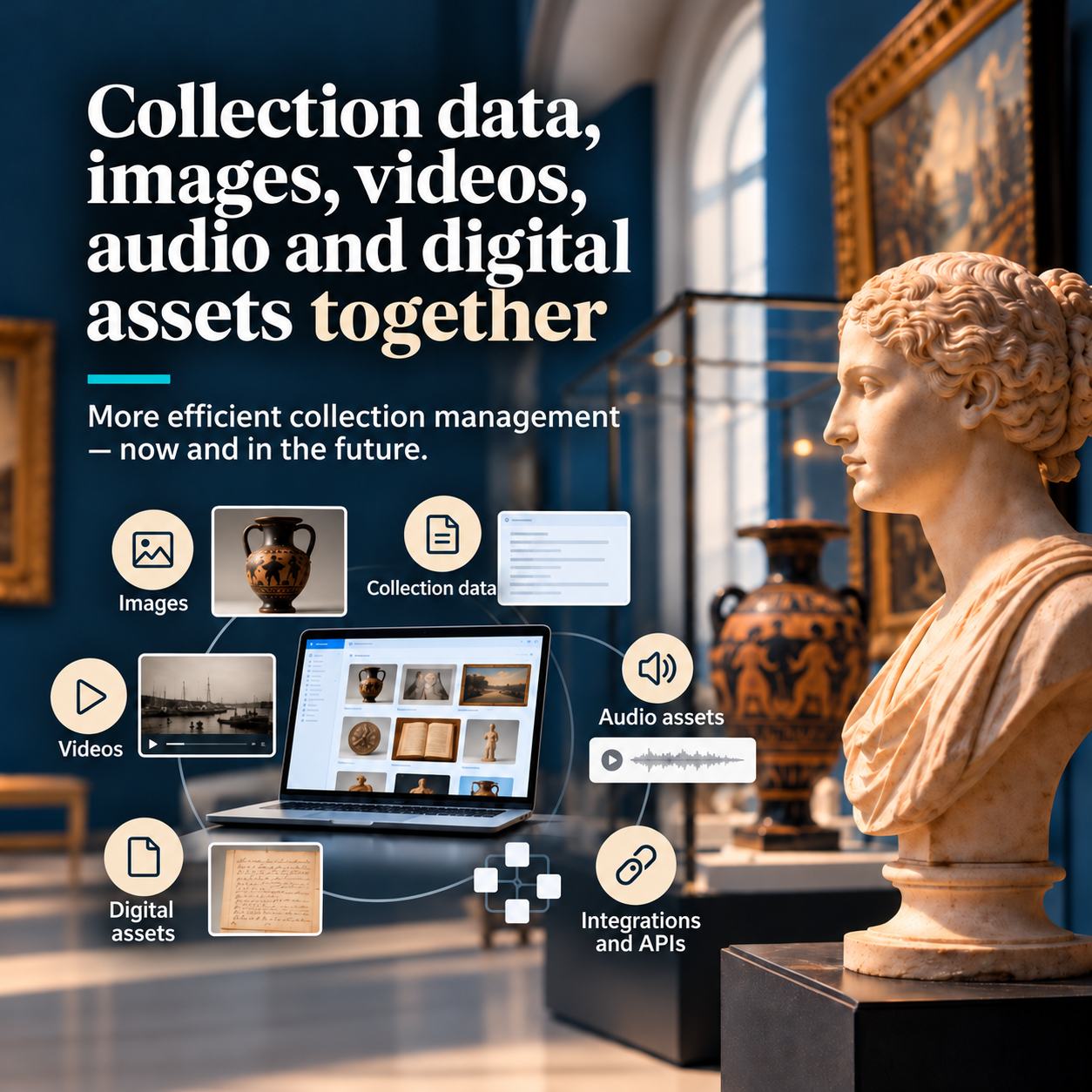
The work of museums and cultural heritage organisations today involves much more than cataloguing and managing objects and collections. Photographs, videos, audio recordings, documents, 3D models and geospatial information make up an increasingly significant part of our digital cultural heritage. At the same time, these assets need to be accessible for research, exhibitions, education, publications and communications.
The latest generation of Collection Pro, combines collection management (CMS) and digital asset management (DAM) within a single platform. The aim is to make information easier to manage, find, use and share – without compromising the requirements museums place on documentation, information security and long-term accessibility.
Flexible Collection Management and Connected Information
One of the key strengths of Collection Pro is its flexible data model. The system can be adapted to different types of collections, cataloguing principles and operational processes without requiring organisations to restrict their documentation to a predefined structure.
Objects, people, places, historical events, documents and digital resources can be described and linked through relationships. This makes it possible to document not only individual objects but also their historical context, provenance, ownership and use history, and connections to other collections.
Collection Pro has been designed with consideration for the Finnish Heritage Agency's museum cataloguing guidelines, which are based on the Spectrum principles. The system can also be configured to support data structures aligned with the CIDOC CRM reference model. The platform can be adapted to support museum workflows such as registration, documentation, exhibitions, loans and conservation.
Images, Video, Audio and 3D Assets in One Environment
Digital collections no longer consist solely of photographs and scanned documents. Collection Pro has therefore been developed to support the management and use of a wide range of digital media formats.
Image management features include viewing, cropping, metadata management and the ability to attach comments and annotations to assets. Video functionality covers the management of large video files, playback, editing and splitting footage into shorter segments. Audio assets can also be managed within the same environment.
Support for 360-degree images, 360-degree video and 3D assets opens up further opportunities for documentation, research and public engagement. For example, an environment, museum object or exhibition can be presented interactively rather than simply as a static image.
These assets can now be viewed and shared directly within the Collection Pro interface, without requiring separate 3D software for each file format. This allows a much wider audience to benefit from the content, rather than limiting access to those who originally created the files. Support for different visualisation technologies, including Gaussian Splatting, further expands the possibilities for working with three-dimensional digital assets.
A common feature of these capabilities is that media files can be linked to relevant collection records, metadata and usage rights. As a result, they become an integral part of the organisation's information resources rather than remaining isolated files scattered across different storage locations.
Better Discoverability and More Consistent Metadata
For digital assets to be reused effectively, they must also be easy to find.
Collection Pro combines structured metadata, classification, full-text search and versatile filtering options. The system can also use established controlled vocabularies and ontologies, for example through Finland's Finto service, to support consistent descriptions and terminology.
AI-based functionality can complement manual cataloguing through image analysis, optical character recognition (OCR) and AI-assisted search. However, these technologies should be regarded as tools that support professional expertise rather than replace the specialist knowledge and quality control provided by museum professionals.
The essential objective is to ensure that information remains understandable, reliable and usable over time.
From Internal Collection Management to Research and Public Access
Digital cultural heritage becomes more valuable when it can also be actively used.
Collection Pro provides role-based access control and the ability to create customised interfaces for different user groups. Museum staff can work with detailed internal information, while researchers, partners and the general public can be given access to selected materials.
Public-facing asset portals, digital exhibitions and download services make it possible to provide access to collections without exposing internal or sensitive information. Usage rights, licensing terms and consent information can be associated with individual assets, making it easier to determine what may be published and shared.
Geospatial information can also be used to describe and visualise the geographical connections of collections, while sensitive location data can be protected.
Integrations and Long-Term Information Management
Collection Pro does not necessarily need to replace all existing systems. The platform can function both as an integrated solution for collection and digital asset management and as a complementary DAM system alongside an existing collection management solution.
For example, integration with MuseumPlus enables collection information and digital assets to be synchronised between the two systems. This reduces the need for manual data transfers and duplicate data entry.
Collection Pro also supports the wider accessibility and distribution of cultural heritage assets through integration with national and international cultural heritage services. These include Finna, Finland’s national discovery service for museum, archive and library collections, and Europeana, the European platform providing access to digital cultural heritage from institutions across Europe. Support for international image interoperability standards (IIIF) enables high-resolution images and related information to be viewed, shared and used across different systems and research environments. Together with open APIs, these capabilities make it easier for museums to publish their collections, reach new audiences and support collaboration between cultural heritage institutions.
Long-term sustainability is particularly important for cultural heritage organisations. A system must support the management of original files, metadata, relationships, access rights and the entire lifecycle of digital assets. Collection Pro can also form part of workflows for transferring material to digital long-term preservation services.
One Platform for the Many Uses of Cultural Heritage
What particularly distinguishes today's Collection Pro is its ability to combine structured collection information with advanced digital media management and utilisation.
For museums, this means that the same information and digital assets can be used across cataloguing, research, exhibition production, education, communications and public services.
For organisations that already have a functioning collection management system, Collection Pro can complement it with modern digital asset management capabilities. For others, the platform can provide the foundation for a more cost-conscious and integrated approach to information management.
In many cases, migrating from an ageing collection management system to a modern solution may also be a necessary step towards ensuring efficient, secure and sustainable management of collections and digital assets in the future.
The objective is not to bring every function into a single system simply for the sake of consolidation. Instead, it is to build a practical and sustainable environment in which cultural heritage information is preserved, managed and made available for controlled and meaningful use – both today and in the future.